
We spoke with Ms. Mónica Cortés Avilés, Executive Director of Asdown Colombia, about what it takes to turn a global commitment into change a child can feel. Asdown Colombia is a non-profit organization that supports persons with intellectual disabilities to lead autonomous lives. As the implementation partner on a project funded by Education Cannot Wait (ECW), Asdown Colombia is proof of how commitments made on a global stage reach the ground.
Of the 85 million school-age children pushed out of school by humanitarian emergencies worldwide, roughly one in five has a disability, and girls with disabilities face the sharpest risks of abuse and exploitation. But how can education safeguard these learners?
Access to education is not limited to books, a classroom, or lessons. In emergencies, a learning space can save a life. It offers food, water, health care, hygiene, mental health support, and protection from exploitation. That is why inclusive education cannot be an afterthought to humanitarian action; it has to be planned and delivered as part of it.
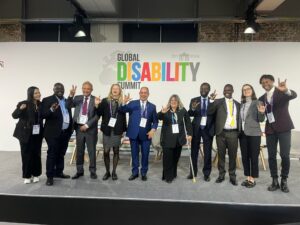
That is the conviction behind ECW’s commitments at the Global Disability Summit 2025. Working with partners, ECW focused on two goals: stronger accountability through better data, and inclusion for all through the twin-track approach. The commitments build on a project led by Inclusion International, with implementation by Asdown Colombia, technical support from the International Disability Alliance (IDA) Inclusive Education Task Team (IETT), and on-the-ground work by the Fédération Nigérienne des Personnes Handicapées in conflict areas.

Aid begins at recognition
Before children with disabilities can be included in a humanitarian response, two groups have to recognize them: the agencies delivering aid, and the organizations of persons with disabilities (OPDs) working inside the crisis. The ECW project built tools and training to support both. Ms Cortés explained why they were needed.
1. Tools that make children visible
Aid reaches only those who are counted, and children with disabilities are routinely uncounted. That is the first barrier. “Agencies have a lot of work in a crisis, but they forget that these children also exist and need to go to school. So, we need to push agencies to use our tools,” Ms. Cortés explained. The ASDOWN team developed standardized tools to identify children with disabilities and understand their specific needs. This data helps actors to work towards including children with disabilities that pass humanitarian crises beyond being mandated by policies.
The ambition reaches past Colombia. Ms. Cortés explained that the tools were built to strengthen OPDs everywhere, not only at home, and that this depends on the sector agreeing to what inclusive education means. “It’s necessary to include these tools to strengthen all the OPDs around the world,” she said. Without a shared vision, she warns, the advocacy stays inconsistent, and inconsistent advocacy is easy for agencies to set aside.
2. Scope of OPDs in emergencies
Ms. Cortés remarked that OPDs and persons with disabilities adapt and learn to live in crises without recognizing a need for change. The need to survive becomes stronger than the strive for change in the face of conflict. To strengthen the intervention, OPDs are a crucial link, so the work becomes one of raising awareness. She shared how this necessitates pushing forward projects that bring together humanitarian organizations to support persons with disabilities.
In the places the project took her, she found people in prolonged crisis stop recognizing the crisis at all. “They don’t recognize that they are in problems, because they learn to live in these places,” she explained. “When you tell them, ‘you are here because of a conflict,’ they say, ‘no, I live here and I’m good.’” That adaptation is exactly what makes children with disabilities disappear from the response: if the people inside the crisis have normalized it, and the agencies outside have overlooked it, no one is counting these children at all. During crises, she noted, the hardest task is convincing parents and caregivers that education matters. With food and shelter taking priority, schooling slips down the list, and the long-term cost of a child missing it is hard to make vivid in the moment. Children end up out of school, and children with disabilities are the most likely to be left out.
“We need to show them that they are in a crisis, that they need help and that children need to go to school to be safe, so they can receive humanitarian help. Because otherwise, in Ukraine, nobody asks what happened to the children with disabilities. Where are they? How are they getting through all of this? Or in Gaza, or in other places,” she added.
Mainstreaming disability inclusion
ECW made a multi-stakeholder commitment with FCDO, IDA, and GEC to adopt the twin-track approach to inclusive education.
The twin-track approach runs on two strategies at once: mainstreaming inclusion across whole systems and targeting specific interventions at community needs. This approach is to ensure that children with disabilities are always on the agenda for education. Ms. Cortes shared her thoughts on the need for collaboration within the movement, “The disability movement has to join with the other education clusters and movements. In Colombia, there’s a big alliance of organizations working on education for children, and we need to be in that space too, pushing them to include our topic.”
She explained it further with a recent example, “this year, Colombia was reviewed by the Committee on the Rights of the Child in Geneva, and the topic of children with disabilities was barely there. Just one person from our CRPD coalition raised it. Many organizations came to speak about children. We need to map all of them, all the groups working on education, so we can move our issues onto their agenda. That’s a good strategy.”
The time to invest is now
According to Ms. Cortés, there are two things that we must do. A commitment made at a global summit can reach a child in a border territory with awareness so first io equipping people to recognize when their rights are being denied is of utmost importance.
Second is an emphasizing the urgent need for funding, “We need to show governments that they have to invest more in these territories, because right now they wait. In my experience, they wait for international cooperation to bring the money, as if the problem isn’t theirs. But Colombia is a country that can invest more.”
That investment case cuts both ways. Colombia’s migration situation has drawn in several cooperants, German, Norwegian, and Canadian government cooperation among them, and Ms Cortés argues these stakeholders need to be mapped to push the financing question rather than left to fill the gap on their own.
The scale of the problem far outstrips what any single project can solve. In their commitments, the ECW also outlined what’s needed: funding, technical expertise, political alliances, and policy change. Lasting change depends on governments, civil society, INGOs, OPDs, and donors all moving together, and the Global Disability Summit exists to give them one platform to do it.